
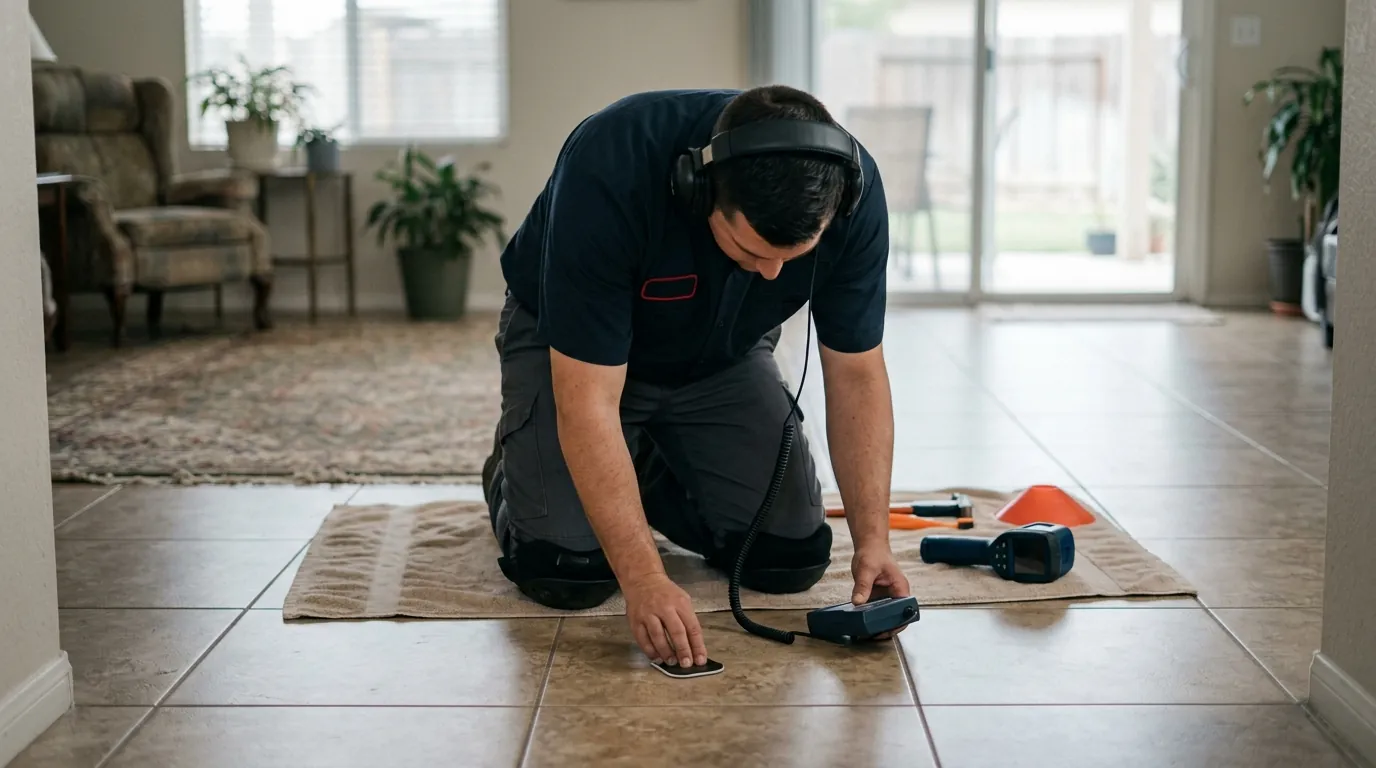
Leak Detection in Bakersfield
Trusted leak detection in Bakersfield, CA. Plumbing and HVAC pros, upfront pricing. Call (661) 863-9242.
Our technicians are headquartered right here in Bakersfield and are typically on-site within 60 minutes of your call.
Bakersfield’s notoriously hard municipal water — some of the highest mineral content in California — leaves scale deposits inside supply lines that gradually narrow flow and mask the early pressure drops that signal a developing leak. Combine that with the slab-on-grade construction that covers virtually every neighborhood from Oleander to Seven Oaks, and a hidden leak here isn’t just a nuisance: it’s water migrating silently through concrete, saturating soil, and showing up on your bill weeks before you notice a damp spot. When your water meter is spinning at 2 a.m. and nothing is running, call All Pro Plumbing Heating and Air at (661) 863-9242 — we’re available around the clock.
Why Bakersfield Properties See More Hidden Leaks
Three local factors stack the odds against homeowners here. First, the slab foundation is nearly universal — from the mid-century bungalows near the Fox Theater corridor to the newer tract homes in Riverlakes Ranch — which means supply and drain lines run beneath concrete rather than through accessible crawl spaces. A pinhole in a copper line under a slab can discharge dozens of gallons a day before the floor feels warm or a grout joint cracks.
Second, pre-1970 homes in Oleander, Westchester, and East Bakersfield were plumbed with galvanized steel supply lines. Galvanized corrodes from the inside out; the rust scale that builds up over decades eventually flakes loose, pits the pipe wall, and creates micro-leaks that are nearly impossible to locate by visual inspection alone.
Third, Bakersfield’s extreme summer heat — routinely above 105°F for weeks at a stretch — accelerates thermal expansion and contraction in buried lines. That daily stress cycle widens existing micro-fractures, turning a slow seep into a measurable loss. Homeowners who notice a spike on their Kern County water bill in August or September are often dealing with a leak that started as a hairline crack the previous spring.
Our Leak Detection Process in Bakersfield
Because most Bakersfield homes sit on slabs, we lead with non-invasive methods before any concrete is touched. The process typically follows these steps:
- Meter and pressure isolation — We shut off fixtures zone by zone and watch the meter to confirm active loss and narrow the source to a specific line.
- Electronic listening equipment — Acoustic amplifiers and ground microphones pick up the distinct frequency of water escaping under pressure, even through 4–6 inches of concrete. Slab leaks produce a characteristic hiss that trained ears can triangulate to within a few inches.
- Thermal imaging — A warm slab leak shows a measurable temperature differential on an infrared camera, helping us cross-reference the acoustic reading before we mark the floor.
- Tracer gas (when needed) — For leaks in drain lines or where acoustic signals are ambiguous, we introduce a safe hydrogen-nitrogen tracer gas and use a sensitive detector at the surface to pinpoint the exit point.
The goal is to open the slab in exactly one spot — not to excavate a trench. Precise location saves you concrete, tile, and labor costs on the repair side.
Equipment & Methods We Use for Leak Detection
Electronic leak detection has replaced the old “break and hope” approach that once meant tearing up entire sections of flooring. The tools we carry are calibrated for the conditions common in Kern County: thick slab pours, the background noise of Bakersfield’s wind, and the mineral-laden soil that can conduct sound differently than looser coastal soils. Correlating acoustic data with thermal imaging gives us two independent confirmation points before we ever pick up a jackhammer. For underground irrigation and service-line leaks in yards — common in the larger lot sizes of Stockdale Estates and Silver Creek — we add electromagnetic pipe locating to trace the exact line path before testing pressure.
Local Note
One pattern we see repeatedly in the ZIP codes closest to the Kern River — 93309 and 93311 — is that expansive clay soil shifts seasonally as groundwater levels fluctuate. That movement puts lateral stress on slab penetrations and on the short sections of pipe that transition from underground to in-slab runs. Homes built in the 1980s and 1990s in these areas often develop leaks at those transition fittings rather than in the straight runs, which means the acoustic signal can appear a foot or two offset from the actual failure point. We account for that offset when we mark the slab, which is why our first core is almost always the right one.
If the leak has already caused water to spread beneath the slab or into adjacent walls, your homeowner’s insurance carrier will want documentation — photos, a written leak report, and the repair invoice. We can provide all three. For the drying and structural rebuild that sometimes follows a significant slab leak, contact a licensed restoration contractor or reach out to your insurer for a referral.
Ready to stop watching your water bill climb? Call (661) 863-9242 any time — day or night — and we’ll dispatch a technician to your Bakersfield address, diagnose the leak with precision equipment, and give you a clear repair quote before any work begins.
Leak Detection in Bakersfield: Service Coverage
Frequently Asked Questions
How fast can you arrive for leak detection in Bakersfield?
How quickly can you reach neighborhoods like Oleander or East Bakersfield for a suspected slab leak?
Are older homes in Westchester and Oleander more likely to need leak detection?
My Kern County water bill spiked but I can't find any wet spots — what's going on?
What does the leak detection process involve, and will you have to break my slab to find the leak?
Will my homeowner's insurance cover a slab leak repair in Bakersfield, and what documentation do I need?
Leak Detection response in Bakersfield
Most Bakersfield calls see a technician on-site within 60 minutes from our Bakersfield headquarters.