Furnace Repair in Bakersfield
Trusted furnace repair in Bakersfield and surrounding areas. Plumbing and HVAC pros, upfront pricing, free estimates. Call (661) 863-9242.
When the heat stops working on a January night in Bakersfield
It doesn’t have to be Minnesota cold for a dead furnace to ruin your week. When overnight temps in the Central Valley drop into the 30s and your thermostat is calling for heat but all you’re getting is lukewarm air — or nothing at all — the problem is real and it needs a real diagnosis, not a reset button and a prayer. Furnace repair covers a specific chain of mechanical and electrical failures: ignition systems that won’t light, heat exchangers that crack and trip safety switches, blower motors that run but don’t move air, and gas valves that close when they should open. Getting the right fix means tracing the fault, not guessing at parts.
What furnace repair actually involves
A furnace that isn’t working is almost never a single obvious failure — it’s a sequence. The thermostat signals a call for heat. The inducer motor spins up to purge combustion gases. The igniter glows or sparks. The gas valve opens. Flame proves to the sensor. The blower delays, then runs. Any one of those steps can break the chain, and each failure leaves a different fingerprint.
Common faults we diagnose and repair include:
- Igniter failure — Hot-surface igniters are ceramic and brittle; they crack from age or from being touched during a previous service call. A cracked igniter draws low amperage, the control board doesn’t see a proper signal, and the furnace locks out.
- Flame sensor fouling — A thin layer of oxidation on the sensor rod prevents it from confirming flame, so the gas valve closes within seconds of lighting. The furnace short-cycles and the homeowner smells a brief gas odor before lockout.
- Cracked heat exchanger — A hairline crack lets combustion gases — including carbon monoxide — migrate into the supply air stream. Most modern furnaces have a pressure switch or roll-out sensor that trips when this happens, which is why a furnace that keeps shutting off for no obvious reason needs a heat exchanger inspection before anything else.
- Inducer motor failure — If the inducer can’t prove negative pressure, the pressure switch won’t close and the ignition sequence never starts. The furnace clicks on, hums briefly, and goes quiet.
- Control board faults — The board sequences every step above. A failed relay or burned trace can mimic almost any other failure, which is why board replacement should come after ruling out the components it controls.
Repair timelines vary: a flame sensor cleaning or igniter swap typically wraps in under an hour. A heat exchanger replacement or blower motor swap is a half-day job. We quote the repair before any work starts.
Our process
-
Thermostat and power verification — Before opening the furnace cabinet, we confirm the thermostat is calling correctly, the disconnect is live, and the filter isn’t so clogged it’s starving the system of airflow. A surprising number of “furnace not working” calls trace back to a tripped high-limit switch caused by a blocked filter.
-
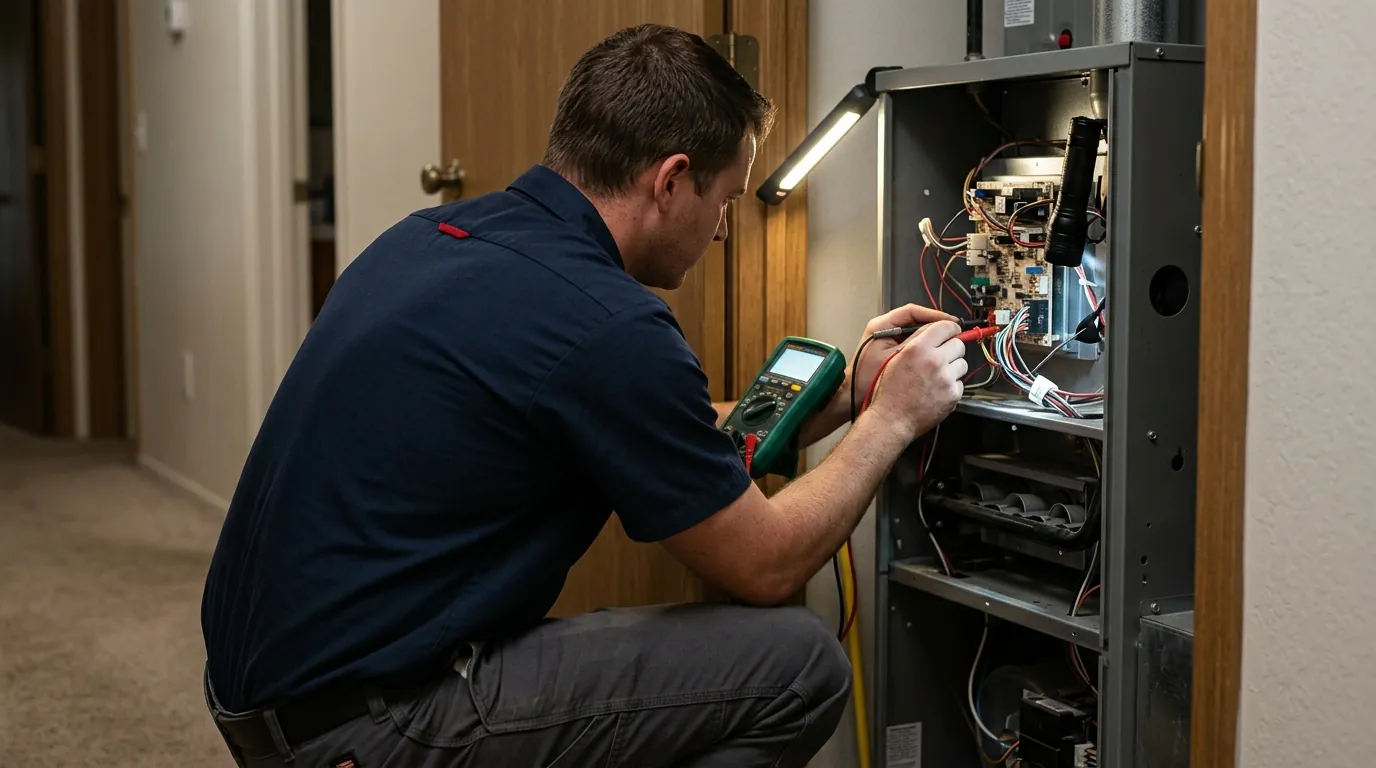
Combustion sequence trace — We walk through the ignition sequence manually, measuring inducer pressure switch closure, igniter resistance and amperage draw, flame sensor microamp signal, and gas valve operation. This tells us exactly where the chain breaks — not which part looks old.
-
Heat exchanger inspection — On any furnace that’s tripping safety switches or is more than eight years old, we inspect the heat exchanger visually and with a combustion analyzer. A cracked exchanger is a carbon monoxide risk and changes the repair conversation significantly.
-
Repair and component verification — We replace the confirmed failed component, then run the furnace through two to three full heat cycles while monitoring supply air temperature rise, gas pressure at the manifold, and CO levels in the flue. A furnace that lights and runs once isn’t necessarily fixed — we verify it runs consistently.
-
Documentation and honest next-step conversation — If the repair cost approaches the value of the equipment, we say so. We’ll give you the repair quote and a replacement ballpark so you can make an informed decision, not one made under pressure at 10 p.m.
What separates a good furnace repair from a bad one
The most common mistake in furnace repair is parts-swapping without diagnosis. A technician who replaces the igniter because it’s the cheapest part and the most common failure — without measuring its resistance or checking the control board output voltage — may fix the symptom this visit and miss the underlying cause. The furnace fails again in three weeks.
A cracked heat exchanger is the fault that gets missed most consequentially. Some technicians do a visual check with a flashlight and call it clear. A proper inspection uses a combustion analyzer in the supply plenum and looks for CO migration during blower operation — not just a visual scan of the primary exchanger panels.
Gas pressure matters too. A furnace that lights but produces weak heat or nuisance lockouts may have low manifold pressure — a gas supply or regulator issue, not a furnace component failure. Skipping a manometer check means chasing the wrong part.
Seasonal and regional considerations
Bakersfield’s furnaces sit idle from roughly April through October, then get called on hard when the valley floor finally cools. That long dormancy is when igniter oxidation, flame sensor fouling, and inducer bearing wear all announce themselves — usually on the first cold night of November when every HVAC company in Kern County is fielding calls simultaneously. Scheduling a furnace check before the heating season means a controlled appointment, not an emergency one. The region’s dusty air also accelerates filter loading and heat exchanger stress; if your furnace is in a garage or utility room near an exterior door, filter replacement intervals should be shorter than the manufacturer’s standard recommendation.
Service area
All Pro Plumbing Heating and Air handles furnace repair throughout Bakersfield and the surrounding Kern County communities, including Oildale, Rosamond, Tehachapi, Delano, Wasco, and Shafter. If you’re in the Central Valley and your heat is out, call (661) 863-9242 — we’re available around the clock.
If your furnace has stopped producing heat, is short-cycling, or is blowing cold air, call (661) 863-9242 now and describe what the system is doing. That detail — the sequence of sounds, the error codes blinking on the board, how long it runs before shutting off — helps us arrive with the right parts and get your heat back on the same visit.
Frequently Asked Questions
My furnace ignites for a few seconds, then shuts off and tries again — what's causing that?
How do I know if my furnace has a cracked heat exchanger, and is it really that serious?
My furnace is running and the blower is on, but the air coming out feels lukewarm or cold — what does that mean?
What's the difference between a furnace tune-up and a furnace repair, and do I need one before the other?
How long does a typical furnace repair take, and will the technician have parts on the truck?
Looking for the best furnace repair company in Bakersfield?
All Pro Plumbing Heating and Air provides furnace repair in Bakersfield, CA and the surrounding area. We answer calls 24/7 — call (661) 863-9242 for immediate help.
Need Furnace Repair now?
We respond 24/7 across Bakersfield and surrounding CA cities.
Related Coverage
- Our Plumbing, Heating and Air Services
- Contact All Pro Plumbing Heating and Air
- Furnace Repair in Bakersfield
- Furnace Repair in Delano
- Furnace Repair in Oildale
- Furnace Repair in Rosedale
- Furnace Repair in Shafter
- Furnace Repair in Taft
- Furnace Repair in Tehachapi
- Furnace Repair or Replace? The 50% Rule and Other Ways To Decide