
Air Conditioning Repair in Bakersfield
Trusted air conditioning repair in Bakersfield and surrounding areas. Plumbing and HVAC pros, upfront pricing, free estimates. Call (661) 863-9242.
When your AC stops cooling on a 105° Bakersfield afternoon
It usually starts subtly — the house climbs a degree or two past the thermostat setting, the air coming from the vents feels lukewarm instead of cold, or the compressor outside runs continuously without ever catching up. By the time the indoor temperature hits 85°F, you’re not browsing options — you’re looking for someone who can get there today. Air conditioning repair in Bakersfield isn’t a luxury call; in a Central Valley summer, a system that’s down or underperforming is a health and safety issue, especially for households with young children, elderly residents, or anyone with respiratory conditions.
What air conditioning repair actually involves
Repair work covers a wide range of failure points, and the right fix depends entirely on what the diagnostic reveals — not on what the system’s age suggests or what a technician guesses over the phone. Common repair scenarios include:
- Refrigerant leaks: When a system is low on refrigerant, it loses cooling capacity progressively. The evaporator coil may ice over, the compressor runs hot, and the system short-cycles. Repair means locating the leak with electronic detection equipment, recovering remaining refrigerant properly, repairing the breach (typically at a coil connection, service valve, or line set fitting), pressure-testing the repaired section, and recharging to manufacturer spec.
- Capacitor and contactor failure: The start and run capacitors that energize the compressor and fan motors are among the most heat-stressed components in any outdoor unit. A weak capacitor causes hard starts, intermittent shutdowns, or a compressor that hums but won’t turn over. Contactors burn and pit over time, causing voltage drop or failure to energize the compressor at all.
- Evaporator and condenser coil issues: Dirty or damaged coils reduce heat transfer efficiency dramatically. A coil clogged with debris in Bakersfield’s dusty summers can drop system efficiency by 20–30% before the homeowner notices anything beyond a higher utility bill.
- Blower motor and fan blade problems: A failing indoor blower motor reduces airflow across the evaporator coil, leading to coil freeze and water overflow at the air handler. Outdoor fan motor failure causes the condenser coil to overheat and the compressor to trip on high-pressure lockout.
- Control board and thermostat faults: Modern systems rely on communication between the thermostat, air handler control board, and outdoor unit. A fault in any of these can mimic a compressor failure or refrigerant problem — making accurate diagnosis essential before any parts are ordered.
Repair timelines vary. A capacitor swap or contactor replacement is typically completed in a single visit. A refrigerant leak repair with pressure testing and recharge takes longer — often two to three hours on-site. Coil replacement or blower motor work may require a parts run if the unit isn’t a common platform.
Our process
-
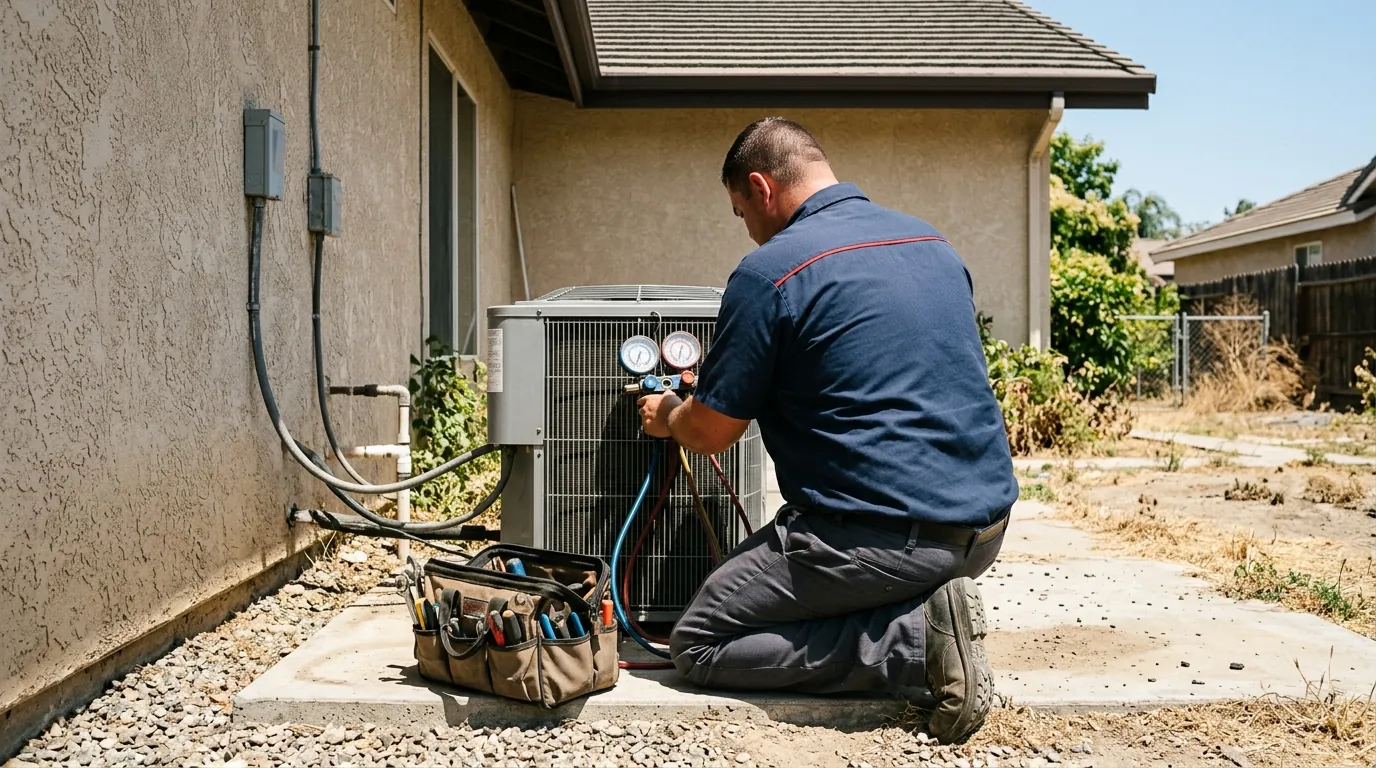
System-wide diagnostic before any repair recommendation. A technician connects gauges to the service ports to read suction and discharge pressures, checks supply and return temperatures, measures static pressure in the duct system, and tests electrical components with a multimeter and capacitor tester. This takes 20–30 minutes and produces a clear picture of what’s actually failing — not what’s easiest to replace.
-
Root-cause identification, not symptom treatment. If refrigerant is low, the leak gets found and fixed before a recharge. If a capacitor failed, the technician checks why — a compressor drawing excessive amperage will burn through a new capacitor in weeks if the underlying issue isn’t addressed.
-
Upfront repair quote before any work begins. Once the diagnosis is complete, you get a specific repair scope and price. The number on the invoice matches the number you approved.
-
Repair, functional test, and performance verification. After the repair, the system runs through a full operating cycle. Supply air temperature, system pressures, and amperage draws are re-checked to confirm the repair resolved the problem and the system is performing within manufacturer parameters.
-
Honest assessment of repair vs. replacement. If the repair cost approaches or exceeds the value of continuing to run an aging system, that conversation happens before you spend money — not after.
What separates a good AC repair from a bad one
The most common mistake in AC repair is recharging a system without finding the leak. Refrigerant doesn’t deplete through normal operation — if a system is low, there’s a breach somewhere. Adding refrigerant without locating and repairing it means the same failure in 6–18 months, plus the ongoing environmental and equipment cost of losing refrigerant to atmosphere.
A second common failure is replacing the most accessible component rather than the one that’s actually failing. A compressor that won’t start is often blamed on the compressor itself, when a failed run capacitor or a tripped internal overload — both inexpensive fixes — is the actual cause. Proper electrical testing before condemning a compressor saves homeowners thousands of dollars.
Finally, a system that’s repaired but not performance-verified may be running, but not running correctly. Confirming supply air temperature differential (typically 16–22°F between return and supply in a properly functioning system) and checking system pressures against manufacturer charts takes an extra 15 minutes and is the difference between a repair that holds and one that comes back.
Seasonal and regional considerations
Bakersfield’s climate is hard on air conditioning equipment in ways that moderate climates aren’t. Outdoor temperatures regularly exceed 100°F from June through September, which means condenser coils are rejecting heat into ambient air that’s already hot — pushing high-side pressures and compressor discharge temperatures to the upper end of their operating range for months at a stretch. Capacitors, contactors, and compressor windings that might last 10–12 years in a milder climate often show stress failure in 6–8 years here. The dust and agricultural particulate in the air accelerates coil fouling and filter loading. Scheduling a pre-season inspection in April or early May — before the first 100° day — catches marginal components before they fail mid-summer.
Service area
All Pro Plumbing Heating and Air runs AC repair calls throughout Bakersfield and the surrounding communities, including Oildale, Rosedale, Shafter, Wasco, Delano, Tehachapi, and McFarland. If you’re in Kern County and your system is down, call (661) 863-9242 — we’re available around the clock.
If your AC is short-cycling, blowing warm air, icing over, or simply not keeping up with the heat, call (661) 863-9242 to schedule a diagnostic. We’ll tell you exactly what’s wrong and what it costs to fix it before any work begins.
Frequently Asked Questions
My AC is running constantly but the house won't cool below 80°F — what's most likely wrong?
Why is ice forming on my indoor AC unit, and is it safe to keep running the system?
How do you find a refrigerant leak, and what does the repair involve?
My AC compressor makes a loud clicking or humming noise when it tries to start — does that mean the compressor needs to be replaced?
How often should AC refrigerant be "topped off," and is that a normal maintenance item?
Looking for the best air conditioning repair company in Bakersfield?
All Pro Plumbing Heating and Air provides air conditioning repair in Bakersfield, CA and the surrounding area. We answer calls 24/7 — call (661) 863-9242 for immediate help.
Need Air Conditioning Repair now?
We respond 24/7 across Bakersfield and surrounding CA cities.
Related Coverage
- Our Plumbing, Heating and Air Services
- Contact All Pro Plumbing Heating and Air
- Air Conditioning Repair in Bakersfield
- Air Conditioning Repair in Delano
- Air Conditioning Repair in Oildale
- Air Conditioning Repair in Rosedale
- Air Conditioning Repair in Shafter
- Air Conditioning Repair in Taft
- Air Conditioning Repair in Tehachapi