
Ductwork Repair and Installation in Bakersfield
Trusted ductwork repair and installation in Bakersfield and surrounding areas. Plumbing and HVAC pros, upfront pricing, free estimates. Call (661) 863-9242.
The room that never gets comfortable
One bedroom runs 10 degrees hotter than the rest of the house. The utility bill climbs every summer even though the thermostat setting hasn’t changed. You hold your hand up to a supply register and feel a whisper of air where there should be a steady push. Nine times out of ten, the problem isn’t the furnace or the AC — it’s the ductwork silently hemorrhaging conditioned air into an unconditioned attic or crawlspace. In Bakersfield’s climate, where summer afternoons routinely push past 105°F, a leaky duct system isn’t a minor inefficiency. It’s the reason your equipment runs nonstop and still can’t keep up.
What ductwork repair and installation actually involves
Duct systems are out of sight and therefore out of mind for most homeowners, but they’re doing serious mechanical work: pressurizing supply runs, maintaining return-air balance, and delivering conditioned air within a few degrees of setpoint to every room in the house. When a duct tears at a flex-duct connection, separates at a trunk line joint, or collapses under the weight of attic insulation, that pressure escapes before it ever reaches a register.
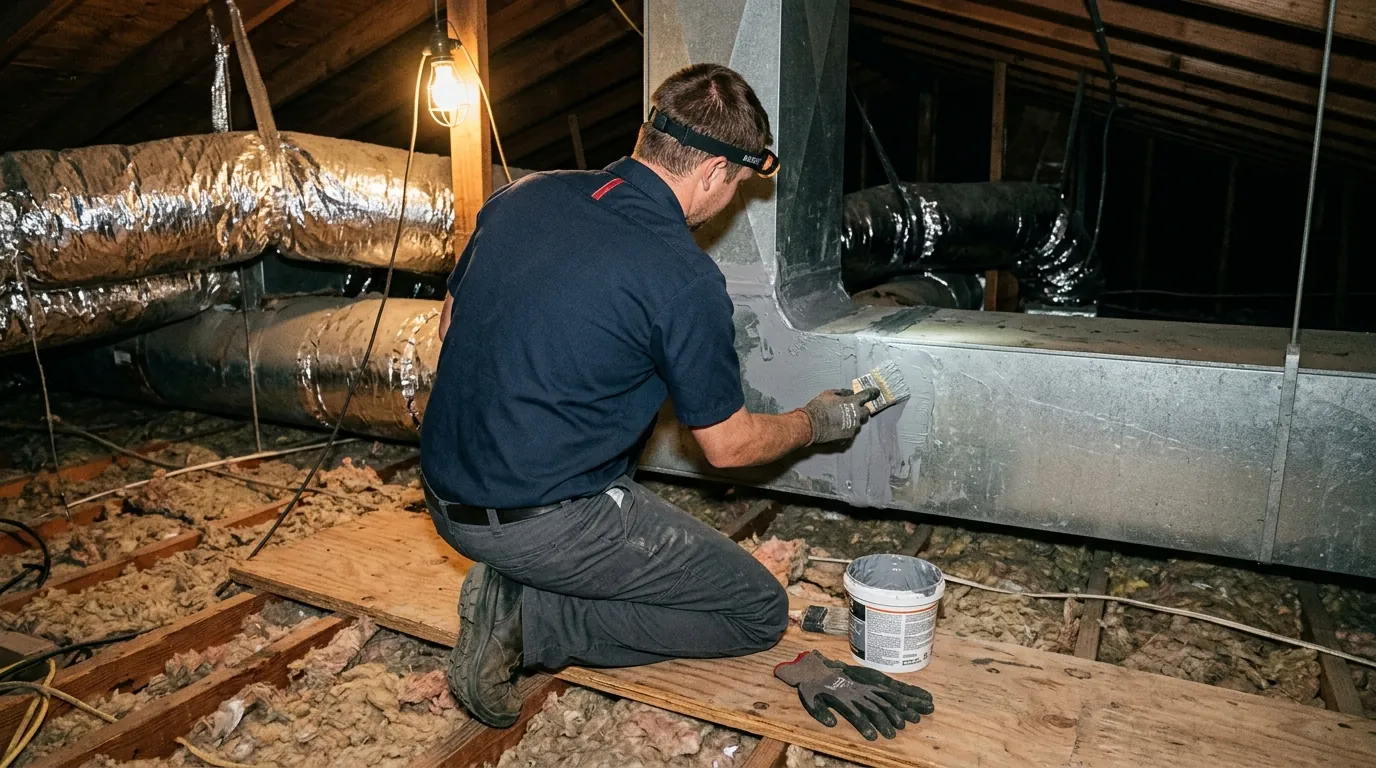
Repair work ranges from mastic-sealing individual joints and reconnecting disconnected flex runs to replacing entire duct sections that have been crushed, rodent-damaged, or degraded by age. Installation work — whether it’s a new system or a full duct replacement — means sizing supply and return branches to the square footage and load of each room, routing runs to minimize friction loss, and sealing every joint before insulation goes back over it.
The equipment involved includes duct blasters and pressure gauges for leakage testing, mastic sealant and foil tape rated for HVAC applications (not household duct tape, which fails within a few years), and flex duct or sheet metal depending on the application. A typical repair visit on an existing system runs two to four hours. A full duct replacement in a single-story Bakersfield home — attic access, new trunk and branch layout, new registers — is generally a one- to two-day project.
Our process
-
Duct leakage test before we touch anything. We pressurize the duct system with a calibrated duct blaster fan and measure how much air escapes at a standard pressure. This gives you a baseline number — CFM25 leakage — so you know exactly how bad the problem is and can measure the improvement after repairs are done.
-
Visual inspection of accessible runs. We walk the attic or crawlspace and photograph every disconnected joint, crushed flex section, unsealed boot, and deteriorated insulation wrap we find. You see what we see before any work is quoted.
-
Repair or replacement, scoped to what the system actually needs. Spot repairs where the ductwork is otherwise sound; full duct replacement where the system is undersized, poorly routed, or too far gone to patch efficiently. We seal all joints with mastic — not tape — and wrap or re-insulate to current standards.
-
Post-repair leakage retest. We run the duct blaster again after work is complete. The numbers don’t lie: you can see the before and after CFM25 figures on the same test report.
-
Airflow and static pressure verification. We check supply and return static pressure at the air handler to confirm the repaired system is operating within the equipment manufacturer’s design range — because a sealed duct that’s still undersized will still make your equipment work too hard.
What separates a good duct job from a bad one
The single most common shortcut in duct work is using standard cloth-backed duct tape on joints instead of mastic sealant or UL 181-rated foil tape. Cloth tape dries out, shrinks, and peels off within a few years in a hot attic — and the leak comes right back. Mastic is messy to apply but it bonds permanently to sheet metal and flex duct alike.
The second common mistake is skipping the post-repair leakage test. Without a duct blaster retest, neither the contractor nor the homeowner has any objective evidence that the repairs actually reduced leakage. Reputable operators test before and after, every time.
On new installations, undersizing the return-air side is a persistent problem. Contractors sometimes run adequate supply but skimp on return trunk size or the number of return grilles, which starves the air handler of airflow and drives up static pressure. High static pressure shortens blower motor life and reduces system efficiency — problems that show up on your utility bill and your repair invoices years later.
Seasonal and regional considerations
Bakersfield’s combination of extreme summer heat and slab-on-grade construction creates specific duct challenges. Most homes here route ductwork through unconditioned attic space where summer temperatures can exceed 140°F. Flex duct exposed to that heat for decades becomes brittle, and the inner liner can delaminate from the outer jacket — collapsing airflow in sections that look intact from the outside. If your system is more than 15 years old and has never had a duct inspection, a leakage test is worth scheduling before the next cooling season starts.
Winter natural-gas heating in the San Joaquin Valley also means combustion appliances sharing the same air handler as the duct system. A large return-air leak near the furnace can create negative pressure that affects flue draft — another reason duct condition matters beyond comfort and efficiency.
Service area
All Pro Plumbing Heating and Air is based in Bakersfield and serves surrounding communities throughout Kern County, including Oildale, Rosamond, Tehachapi, Shafter, Wasco, and Delano. City-specific ductwork pages link back here for full technical detail.
If your home has a room that never reaches setpoint, a utility bill that keeps climbing, or an AC that runs all day without catching up, call (661) 863-9242 to schedule a duct leakage test — and find out exactly how much conditioned air you’ve been paying to heat your attic.
Frequently Asked Questions
What is a duct blaster test and what does it actually measure?
Why does mastic sealant matter more than duct tape on duct joints?
How do I know if my ducts need spot repairs or a full duct replacement?
Can leaky ductwork affect indoor air quality, not just comfort and efficiency?
How long does a full duct replacement take in a typical Bakersfield home?
Looking for the best ductwork repair and installation company in Bakersfield?
All Pro Plumbing Heating and Air provides ductwork repair and installation in Bakersfield, CA and the surrounding area. We answer calls 24/7 — call (661) 863-9242 for immediate help.
Need Ductwork Repair and Installation now?
We respond 24/7 across Bakersfield and surrounding CA cities.
Related Coverage
- Our Plumbing, Heating and Air Services
- Contact All Pro Plumbing Heating and Air
- Ductwork Repair and Installation in Bakersfield
- Ductwork Repair and Installation in Delano
- Ductwork Repair and Installation in Oildale
- Ductwork Repair and Installation in Rosedale
- Ductwork Repair and Installation in Shafter
- Ductwork Repair and Installation in Taft
- Ductwork Repair and Installation in Tehachapi