
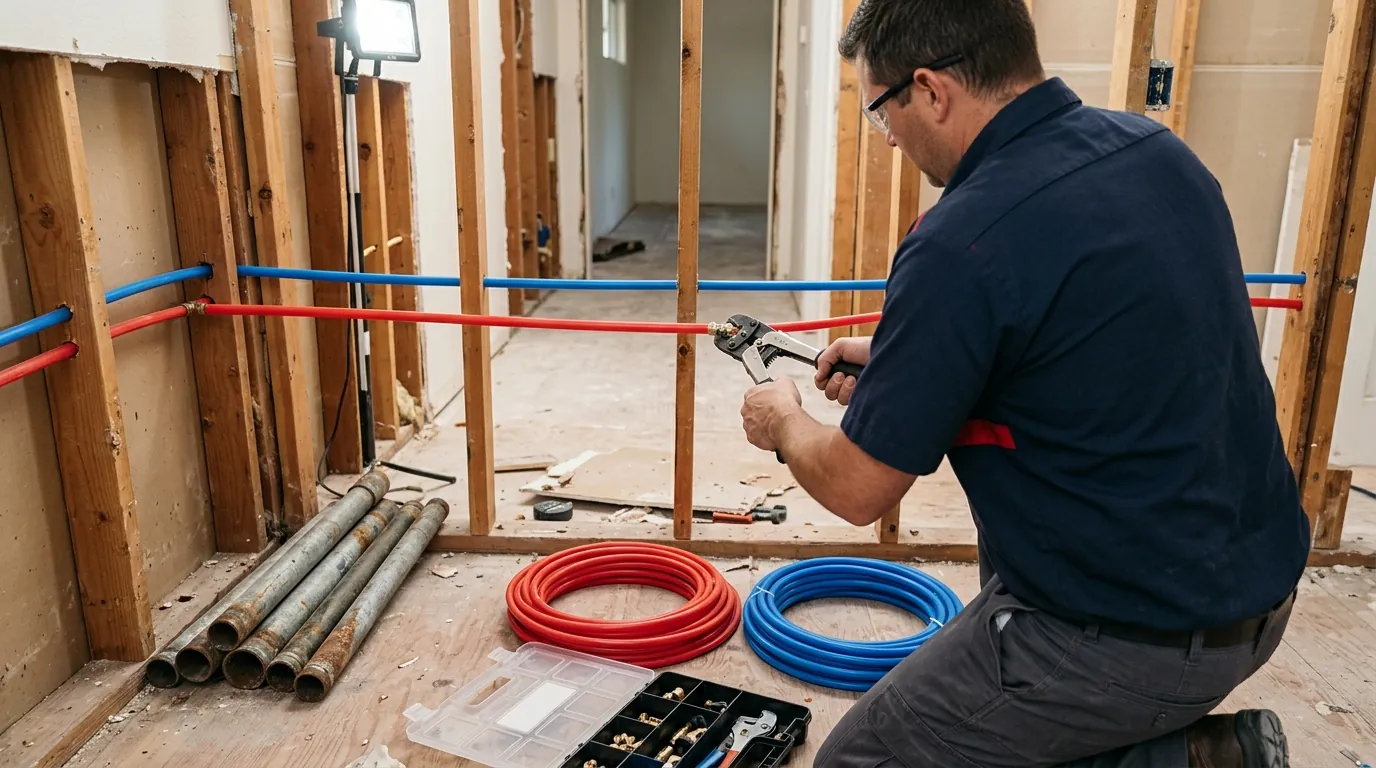
Whole-House Repiping in Bakersfield
Trusted whole-house repiping in Bakersfield and surrounding areas. Plumbing and HVAC pros, upfront pricing, free estimates. Call (661) 863-9242.
When the water pressure in your Bakersfield home has been quietly dropping for years — a trickle at the showerhead while the dishwasher runs, rust-colored water on Monday mornings, pinhole leaks that keep appearing in different walls — the problem usually isn’t a single bad fitting. It’s the pipe material itself. Whole-house repiping replaces every supply line from the meter to the fixtures in one coordinated project, so you’re not patching the same failing system indefinitely.
What whole-house repiping actually involves
A full repipe replaces all the pressurized supply lines inside your home — the hot and cold branches that feed every sink, toilet, shower, tub, hose bib, and appliance. It does not typically include drain, waste, and vent lines (those are a separate scope if needed).
The two most common materials used today are copper and PEX:
- Copper repiping uses rigid Type L or Type M copper with soldered or press-fit connections. It’s the long-proven standard, compatible with Bakersfield’s hard water when properly sized, and adds resale value that buyers and appraisers recognize.
- PEX repiping uses flexible cross-linked polyethylene tubing with crimp, clamp, or expansion fittings. PEX runs through walls and ceilings with fewer penetrations, handles the thermal swings between a 105°F attic and a cold-water supply line without stressing joints, and resists the scale buildup that shortens copper’s lifespan in areas with high mineral content.
For a typical 3-bedroom, 2-bath Bakersfield home, a repipe crew works one to two days. Walls are opened at access points — usually small, targeted cuts rather than full drywall removal — and patched as part of the project scope. Water is off during active work but restored each evening if the job spans two days.
Galvanized steel pipe replacement and polybutylene pipe replacement follow the same general scope. Galvanized lines common in pre-1970s Kern County housing stock corrode from the inside out, slowly strangling flow. Polybutylene — installed widely through the 1980s and early 1990s — degrades with chlorinated municipal water and fails without warning.
Our process
-
Whole-home assessment and material recommendation. A plumber walks every fixture location, identifies the existing pipe material, checks water pressure at multiple points, and inspects accessible lines in the attic, crawlspace, or garage. The assessment determines linear footage, access complexity, and whether copper or PEX is the better fit for your home’s layout and water chemistry.
-
Permit application and scheduling. In Bakersfield, a repipe requires a City of Bakersfield plumbing permit. We pull the permit before work begins. This protects you — an unpermitted repipe can complicate a home sale or insurance claim years later.
-
Systematic pipe replacement, room by room. The crew works from the main shutoff outward, replacing trunk lines first, then branch lines to each fixture group. Access cuts are kept as small as structurally possible. All new lines are pressure-tested before walls are closed.
-
City inspection and sign-off. A Bakersfield building inspector verifies the installation before drywall patches go in. This is the step that confirms the work meets California Plumbing Code — not just our word, but a third-party sign-off.
-
Drywall patching and site cleanup. Access openings are patched, textured to blend, and left ready for paint. We remove all old pipe material and construction debris. You get a clean house and documentation of the passed inspection.
What separates a good repipe from a bad one
The most common shortcut in repiping is inadequate pipe sizing. Replacing old galvanized with the same nominal diameter sounds logical, but corroded galvanized often ran undersized to begin with. A proper repipe recalculates flow demand for the fixture count and upsizes trunk lines where needed — the difference between pressure that actually satisfies and a new system that still disappoints.
A second failure point is improper PEX installation in hot attic spaces. Bakersfield attics routinely exceed 140°F in summer. PEX must be rated and installed with adequate support spacing and UV protection where it’s briefly exposed; undersupported runs in extreme heat sag and stress fittings over time.
Skipping the permit is the mistake that costs homeowners the most in the long run. A repipe done without a permit has no inspection record. If a leak develops, a homeowner’s insurance carrier can dispute the claim on the grounds that the work was unpermitted. When the house sells, an unpermitted repipe surfaces in disclosure and can kill a deal or require a costly retroactive inspection.
Finally, watch for crews that leave old pipe in place and simply abandon it. Abandoned galvanized lines can still hold standing water and corrode into adjacent framing. Removed pipe is the correct standard.
Seasonal and regional considerations
Bakersfield’s water supply carries some of the highest mineral hardness levels in California, a byproduct of the Sierra Nevada snowmelt and groundwater sources that feed the area. Scale accumulates inside copper lines over decades, eventually restricting flow almost as badly as corroded galvanized. If your home has original copper from the 1970s or earlier and you’re seeing reduced pressure, the pipe interior may be heavily scaled rather than the pipe being intact. A camera inspection or cross-section of a removed section will confirm it.
The valley’s temperature extremes also matter for material selection. Homes with significant attic runs in Bakersfield’s climate often perform better long-term with PEX, which flexes with thermal expansion rather than working solder joints over thousands of heat cycles.
Service area
All Pro Plumbing Heating and Air performs whole-house repiping throughout Bakersfield and the surrounding communities, including Oildale, Rosedale, Shafter, Wasco, Delano, Tehachapi, and the broader Kern County area. City-specific pages cover local permit requirements and regional pipe-material considerations in more detail.
If your water pressure has been declining, you’ve had multiple pinhole leaks, or a plumber has told you your galvanized or polybutylene lines are past their service life, call (661) 863-9242 to schedule a whole-home pipe assessment. We’ll show you what’s in the walls, walk you through the copper vs. PEX tradeoffs for your specific home, and give you a written quote before any work begins.
Frequently Asked Questions
How do I know whether my home needs a full repipe versus targeted repairs on a few bad sections?
What is the difference between copper and PEX repiping, and which is better for Bakersfield homes?
Does a whole-house repipe in Bakersfield require a permit, and what does the inspection cover?
How much of my drywall will be cut open, and who patches it?
How long will the water be off during a whole-house repipe?
Looking for the best whole-house repiping company in Bakersfield?
All Pro Plumbing Heating and Air provides whole-house repiping in Bakersfield, CA and the surrounding area. We answer calls 24/7 — call (661) 863-9242 for immediate help.
Need Whole-House Repiping now?
We respond 24/7 across Bakersfield and surrounding CA cities.
Related Coverage
- Our Plumbing, Heating and Air Services
- Contact All Pro Plumbing Heating and Air
- Whole-House Repiping in Bakersfield
- Whole-House Repiping in Delano
- Whole-House Repiping in Oildale
- Whole-House Repiping in Rosedale
- Whole-House Repiping in Shafter
- Whole-House Repiping in Taft
- Whole-House Repiping in Tehachapi
- Low Water Pressure in Your House? Here Are the Usual Suspects